
Guide
Claude Training for Businesses in South Tyrol: What Claude Can Do for Your Team
What Claude by Anthropic does in day-to-day business, which plan fits your data, and how a hands-on Claude training session in South Tyrol works, in German or Italian.
· Julian Sommavilla · 10 min read
Why so many people in South Tyrol are searching for Claude
In the province of Bolzano, the search term “claude” gets around 8,100 Google searches a month on average. Over twelve months the monthly figure rose from about 1,300 to 12,100 (our own Google Ads Keyword Planner query for the province of Bolzano, November 2026). For businesses, that raises two questions: is Claude worth it for us, and how do we get the team using it well?
At Alpino AI we work with Claude and Claude Code every day. This article covers what Claude can do in a business, what to watch out for with plans and data, and how a Claude training session with us works. We checked the facts about Claude against Anthropic's own pages in November 2026. Plans and terms change often, so check the latest terms before you decide.
What is Claude?
Claude is an AI assistant made by the US company Anthropic. You use it in the browser, in the desktop app or on your phone: describe what you need, and Claude writes, summarises, analyses or builds something. The interface is available in German and Italian, and you can write to it in many languages, including German and Italian.
Ways a business can use Claude:
- Texts and quotes: draft emails, quotes or job ads, in German and Italian if needed.
- Summarising documents and contracts: boil down a long PDF or a draft contract and ask targeted questions. This does not replace a legal review.
- Working with spreadsheets: upload an Excel or CSV file and ask questions about the data.
- Projects with your own knowledge: a project bundles your files and standing instructions, so price lists, templates or house rules don't need explaining every time. Projects are available on all plans, with up to five on Free. On Team and Enterprise they can be shared within the organisation.
- Artifacts: larger outputs such as a document, a presentation or a small tool appear next to the chat and can be edited and shared. Artifacts are available on all plans. On Team and Enterprise, the organisation decides whether they can be shared externally.
- Connectors: on all plans, Claude can connect to Microsoft 365 or Google Workspace. On Team and Enterprise, an owner of the organisation has to enable these connectors first.
- Claude Code for technical teams: it works directly with code and project files, writes and changes programs and explains existing code. It is included in Pro, Max and Ultra and on every Team seat. On Enterprise it depends on the contract and seat type.
We already have Copilot or ChatGPT. Do we need Claude?
Not necessarily. Microsoft Copilot is an obvious choice where a business already works in Microsoft 365, and many employees already know ChatGPT. Compare them on a task from your own business. Look at the quality of the results, the available integrations and the contracts on offer for businesses. Our advice is to roll out one tool properly rather than three halfway. If Claude isn't the right fit for you, we'll say so. For when a standard tool is enough and when a custom solution pays off, see ChatGPT vs. Custom AI Solutions.
Why train people when they can just try it?
Trying it out is a good start. Some of your staff may already use Claude or similar tools, possibly on personal accounts. There are three things to get right.
The wrong plan for business data
Anthropic separates personal plans (Free, Pro, Max and Ultra) from business plans (Team and Enterprise):
| Personal plans | Team and Enterprise | |
|---|---|---|
| Model training | depends on an account setting | not by default |
| Contract | consumer terms | commercial terms with a data processing addendum (DPA) |
| Administration | everyone on their own | administrators, single sign-on, connector approval |
| Chat history | kept until deleted | kept until deleted, configurable period on Enterprise |
On personal plans, you decide in the privacy settings whether Anthropic may use your chats to improve its models. With the setting on, new or resumed chats and coding sessions may be kept in de-identified form for up to five years for training. On Team and Enterprise, Anthropic does not use inputs and outputs for training by default. The exception is voluntary feedback: if someone rates a response with a thumbs up or down, the related conversation may be used for training and stored for up to five years.
Regular chats stay in the history until you delete them. On Enterprise, the organisation can set its own retention period. After deletion, Anthropic normally removes chats from its back-end systems within 30 days. Special rules apply to safety cases, such as chats flagged for usage policy violations, and to retention required by law. On Team and Enterprise, Anthropic acts on behalf of your company for the processing covered by the data processing addendum.
In practice: customer data, HR data and trade secrets do not belong in personal accounts. Even on a business plan, you need a clear rule on which data may go in, because the plan alone does not yet make it lawful to process personal data. Read more in AI and Data Privacy in the EU and Using AI securely.
Good results need a good way of working
Claude gives better answers when it knows the context: who is writing to whom, for what purpose, in what tone and based on which documents. Set that up once in a project and you don't have to repeat it. Checking matters just as much. Language models state wrong information with confidence, which is known as hallucination. Figures, legal references, names and deadlines should always be checked against the source.
AI literacy is a legal duty
Article 4 of the EU AI Act (Regulation (EU) 2024/1689) has applied since 2 February 2025. Amending Regulation (EU) 2026/1744, known as the Digital Omnibus on AI, was published in the Official Journal of the EU on 24 July 2026 and entered into force on 27 July 2026. Since then, providers and deployers of AI systems must take measures that support the development of AI literacy. This covers their own staff and other people working with AI on their behalf. The measures should reflect prior knowledge and how the systems are used. No specific level or certificate is required. Training tailored to your team's tasks can be one such measure. This is not legal advice.
How a Claude training session works with us
Each session is tailored to your business. This is the sequence:
- Short preliminary call: we find out which tasks take up the most time, who will take part and which tools are already in use.
- Work on real tasks: participants practise on anonymised tasks from your own business. A quote text from your sector teaches more than a generic example.
- Rules for data: together we agree which data may go into Claude, which stays out and which plan that requires. The result is a short written rule for the company.
- Reusable templates: we set up projects with instructions and sample files with you, for example for quotes or customer enquiries. Your team keeps working with them afterwards.
- Deep dives where needed: for technical staff we cover Claude Code; for management, planning, rules and accountability.
- Follow-up session: after a few weeks we look together at what works in daily use and where things still get stuck.
Sessions run in German or Italian, on site at your premises in South Tyrol or online. Whether a training session can be funded is something we assess case by case; for an overview of the programmes, see our funding guide for South Tyrol. Training on phishing, fake calls and CEO fraud is a separate topic we cover under Software and cyber security.
Three everyday examples
The following examples are simplified and show possible workflows, not measured results.
Trades: quotes
Before: in the evening the owner writes quotes in German and Italian, piecing the text together from old Word files.
After: a Claude project holds service descriptions, standard paragraphs and examples of the company's tone. A few notes on the job turn into a draft in both languages, which the owner checks and uses. He still calculates the prices himself. Supporting the pricing itself from past orders takes a dedicated solution, as in our quote automation use case.
Manufacturing: analysing complaints
Before: quality assurance collects complaints in an Excel sheet and analyses them by hand once a quarter.
After: for the exercise, the team uses a spreadsheet without any personal data. Claude groups the cases by defect type and product and prepares a summary as an artifact. The person responsible checks the results before adding them to her report.
Hospitality: guest enquiries
Before: reception answers the same questions about arrival, spa or pets from scratch every day, in three languages.
After: a project contains house rules, extra services and reply templates. Staff paste in the enquiry without guest data and get a draft in the guest's language, which they check and send. Answering guests directly around the clock takes a dedicated hotel assistant.
When training is not enough
As soon as a process depends on your ERP or file server, has to respect permissions or should trigger actions in other systems, you need a custom solution, the kind we build under AI automation. If you want to try out an internal application first, the article on prototyping a company app shows one way.
Free initial consultation
If you are thinking about introducing Claude or training your team, get in touch. In a free initial consultation we look at which tasks are a good fit, which plan suits you and what a training session could look like for your business.
Frequently asked questions
Is our data used to train the models?
On Team and Enterprise, not by default. The exception is voluntary feedback, such as a thumbs up or down rating. On personal plans, it depends on the model improvement setting in the account. Chats flagged for possible usage policy violations follow their own rules. Anthropic describes the details for personal plans and for Team and Enterprise.
Claude, ChatGPT or Copilot?
What matters are the tools your team already uses, the business contracts on offer and the tasks you want to solve. In our training we work with Claude. The principles, giving context, checking results and setting rules for data, apply to all of these tools.
Does Claude work in German and Italian?
Yes. The interface can be set to German or Italian, and you can write to Claude in many languages, including German and Italian, even mixing them. Claude is officially available in Italy.
Do we need Claude licences before the training?
We clarify that in the preliminary call. For work with real business data we recommend a business plan.
Sources
As of November 2026
- Claude: plans and features
- Anthropic: Is my data used for model training? (personal plans)
- Anthropic: Is my data used for model training? (Team, Enterprise and API)
- Anthropic: How long do you store my data?
- Anthropic: How long do you store my organization's data?
- Anthropic: Data Processing Addendum (DPA)
- How to use Claude in your preferred language
- EU AI Act, Regulation (EU) 2024/1689, on EUR-Lex
- Amending Regulation (EU) 2026/1744 on EUR-Lex
Keep reading
 Guide
ChatGPT vs. Custom AI Solutions: When Does Each Make Sense?
Learn when ChatGPT is enough and when a custom AI solution is the better choice for your business.
· 5 min read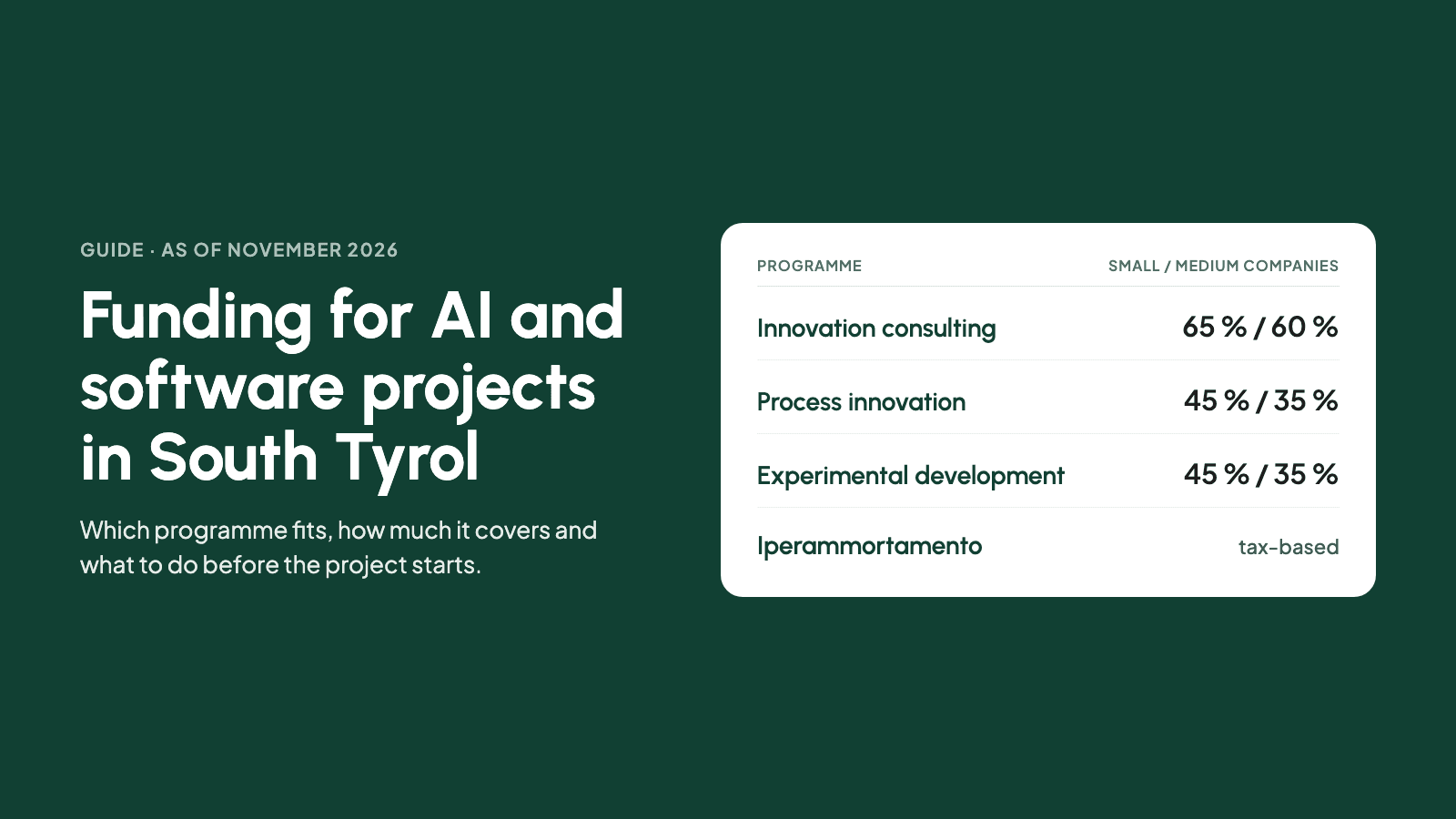 Guide
Funding for AI and Software Projects in South Tyrol: Which Programme Fits?
Funding for AI and software projects in South Tyrol: process innovation, innovation consulting, experimental development and the Iperammortamento, with rates, limits and a first step.
· 9 min read Guide
AI & Data Privacy in the EU: What SMEs Need to Know
GDPR, the EU AI Act, and using AI responsibly: a practical guide for small and medium businesses that want to innovate without compromising on privacy.
· 6 min read
Next step
Want to find out where AI actually makes sense for you?
We translate the article into concrete workflows: which task is worth automating, which data is needed and how small the first MVP can be.