
Guide
Purchasing Forecasts: Less Capital in Stock, Better Terms
How a purchasing forecast lowers tied-up capital and earns better supplier terms: from the everyday problem through a limited pilot to human approval.
2026-09-01 · Alpino AI · 5 min read
The problem starts with the order quantity
At the end of every month the same question comes up: how much capital is sitting in the warehouse, and how much of it will barely move over the next few weeks? In many retail businesses the order quantity comes from experience and the last order sheet. One item ran short once, so next time you order more generously. Another sells more slowly than expected but keeps arriving on the usual schedule. You know the result from your own stockroom: full shelves of items that sit there, and gaps in exactly the goods customers ask for.
The business is not badly run. It has grown, the ranges have widened, and the number of items has long passed what one person can hold in their head. Purchasing keeps the shop running, but it does so for hundreds or thousands of positions at once, each with its own demand and its own lead time. That is where experience loses the overview.
The cost lands in two places at once. Capital tied up in slow-moving goods is not available for buying, staff, or planned investment. And whoever has to reorder at short notice usually pays more for it: small quantities, weaker volume pricing, and the occasional rush shipment. Both effects are easy to miss, because they spread across the whole range and never show up as a single number.
What changes with a forecast
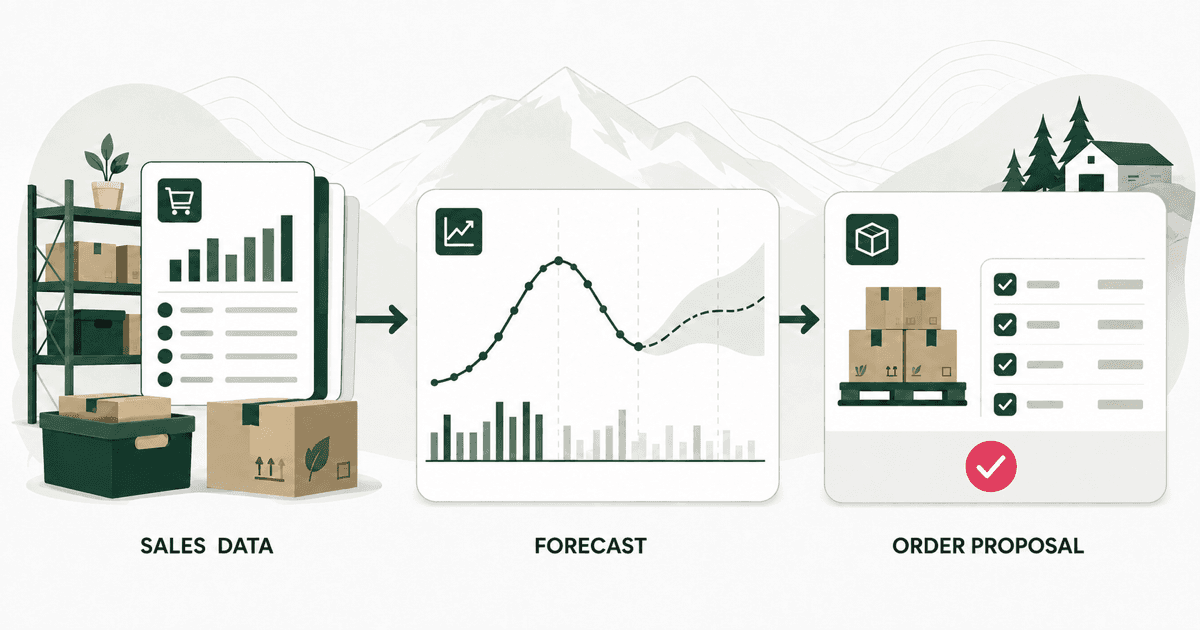
A purchasing forecast answers one plain question per item: how much is likely to sell in the coming weeks, and when should you therefore reorder, and how much? It runs on data your business already has: sales history, current stock, lead times, and supplier minimum order quantities. The model accounts for seasonal patterns and weekly rhythms, because across the last few years it picks up what a person can no longer track over thousands of items.
The benefit can be calculated. Less capital stays locked in goods that turn slowly. For the rest, orders group into larger, plannable quantities, and larger quantities at the right time bring better volume pricing and fewer costly rush orders. Instead of an invented percentage we point you to the measurement point: the average capital tied up in stock and the number of short-notice reorders, before and after the pilot. Those two figures show you in black and white whether the model pays off.
Running a limited pilot
There is no overhaul of the whole purchasing function at the start. We begin with one defined product group that has enough sales history and that visibly ties up capital. The boundary is deliberate: the team keeps the overview, and if something does not fit, the mistake stays small and visible.
The steps:
- Review the data. We read sales history, stock, and lead times from your ERP system and check how complete and clean they are.
- Run the model. For the pilot product group we produce a forecast per item, along with an order suggestion that states quantity and timing.
- Run it in parallel. For a few weeks the suggestion runs alongside your usual purchasing. Your buyer sees what the model would recommend but still decides.
- Compare. At the end we set the suggestions against what actually happened and measure capital tied up and reorders.
A pilot this size takes weeks, not months. It runs on your real figures and not on a sample. At the end there is a clear decision: extend, adjust, or drop it. Because the pilot stays small, the investment stays manageable and the risk is contained.
Where human approval stays
The model orders nothing. It calculates and suggests. Every order reaches purchasing as a proposal, with quantity, timing, and the numbers behind it, and only your employee's approval releases it. That keeps the knowledge in the house effective: an announced promotion, a supplier shortage, or a customer with special demand, the kind of thing no sales history contains.
The forecast makes the decision faster and better grounded, and responsibility stays with purchasing. Your team sets the limits: up to which quantity a suggestion goes through without a query, and from where someone has to take a look. Who approved which suggestion, and when, is documented so it can be traced. For the buyer the work shifts from gathering the numbers to checking them and deciding.
How this fits our work
We build solutions like this so that they fit your existing processes. The forecast connects to your ERP system and delivers the suggestions where purchasing already works. The data stays in your environment, GDPR-compliant and, if you wish, on your own infrastructure. What works in purchasing can later extend to sales forecasts or to analysing stock turnover. You will find an overview of what we offer under our services.
Next step
If you want to know how much capital is sitting in slow-moving goods in your business, we will work it out on one product group. Book a 30-minute first call through our contact page, and we will find out whether a purchasing pilot fits your business.
Next step
Want to find out where AI actually makes sense for you?
We translate the article into concrete workflows: which task is worth automating, which data is needed and how small the first MVP can be.