
Guide
Cyber Resilience Act: what manufacturers of machines and devices with software need to know now
Cyber Resilience Act (EU) 2024/2847: who it covers, which deadlines apply, what manufacturers must do and how to prepare the documentation. Status as of 25 Nov 2026.
· Julian Sommavilla · 9 min read
Who the Cyber Resilience Act applies to
Anyone who makes machines, plants, controllers, sensors, gateways or software with a data connection to a device or network and places them on the EU market should know the Cyber Resilience Act (CRA). It entered into force on 10 December 2024 as Regulation (EU) 2024/2847 and governs the cybersecurity of products.
Under Article 2(1) it applies to products with digital elements made available on the market whose intended purpose or reasonably foreseeable use includes a direct or indirect logical or physical data connection to a device or network. This covers hardware and software, including components placed on the market separately. A remote data processing solution can be part of the product, for example a cloud connection or an app, if its software was designed and developed by the manufacturer or under its responsibility and the product could not perform one of its functions without it (Article 3). The CRA does not apply to products to which Regulations (EU) 2017/745 (medical devices), (EU) 2017/746 (in vitro diagnostic devices) or (EU) 2019/2144 (motor vehicles) apply (Article 2(2)). Whether a particular piece of software or a cloud component belongs to the product is addressed in the European Commission guidance of 27 July 2026. It is not binding, but it contains examples for small and medium-sized enterprises.
The obligations fall mainly on manufacturers. Authorised representatives, importers and distributors have obligations of their own. An importer or distributor that places a product on the market under its own name or trademark, or modifies it substantially, is treated as the manufacturer under Article 21.
The deadlines
| Date | What applies |
|---|---|
| 10 December 2024 | The CRA entered into force. |
| 11 June 2026 | Chapter IV (Articles 35 to 51) applies: rules on the notification of conformity assessment bodies. |
| 11 September 2026 | Article 14 applies: manufacturers must report actively exploited vulnerabilities and severe incidents. |
| 11 December 2027 | The regulation applies in general. |
The dates come from Article 71 of the regulation and the European Commission overview.
For products placed on the market before 11 December 2027, the other requirements apply under Article 69(2) only if the products are substantially modified from that date. The reporting obligation under Article 14 is a separate matter: under Article 69(3) and the ENISA FAQ it has applied since 11 September 2026 to products already placed on the market that are within scope.
What manufacturers must do
The core obligations are in Article 13 and Annex I. In practice they can be summarised in six points.
1. Assess cybersecurity risks. Manufacturers assess the cybersecurity risks of their product and take the result into account in planning, design, development, production, delivery and maintenance (Article 13(2)). They document the assessment and update it where necessary during the support period (paragraph 3).
2. Handle vulnerabilities. Annex I, Part II requires vulnerabilities and components to be documented. This includes a software bill of materials (SBOM) in a commonly used, machine-readable format that covers at least the top-level dependencies of the product. If the manufacturer finds a vulnerability in an integrated component, it reports it to whoever makes or maintains the component and handles and remedies it in line with Annex I, Part II (Article 13(6)).
3. Set a support period. The period must reflect the expected product lifetime and is at least five years. It may be shorter only if the expected product lifetime is shorter (Article 13(8)). Each security update remains available from its release for at least ten years. If the remaining support period is longer, that longer period applies (Article 13(9)).
4. Keep technical documentation and assess conformity. This includes the technical documentation (Article 31) and the chosen conformity assessment procedure (Article 32). For products in the regular procedure, internal control (Module A) is available. For important products of Classes I and II and for critical products (Annexes III and IV), additional requirements for assessment or certification apply depending on the classification, in part through a conformity assessment body.
5. Issue the EU declaration of conformity and affix the CE marking. Conforming products carry the CE marking.
6. Report when it matters. Since 11 September 2026 the following applies: when a manufacturer becomes aware of an actively exploited vulnerability or a severe incident affecting the security of the product, it reports without undue delay and at the latest within these deadlines:
- early warning within 24 hours of becoming aware,
- notification with the information still missing no later than 72 hours after becoming aware,
- final report: for vulnerabilities no later than 14 days after a corrective or mitigating measure is available, for incidents within one month after the 72-hour notification.
Each stage is submitted centrally through ENISA's Single Reporting Platform. It goes to the competent coordinating CSIRT, and ENISA receives the information at the same time as a rule (European Commission on the reporting obligation).
Infringements of Annex I and Articles 13 and 14 can be penalised with fines of up to EUR 15 million or, for undertakings, 2.5% of total worldwide annual turnover of the preceding financial year, whichever is higher (Article 64(2)). Manufacturers that are micro or small enterprises are exempt from these fines for missing the 24-hour early warning deadline (Article 64(10)). The reporting obligation remains.
First steps in your business
This order works for a first inventory:
- List all products that contain software or can connect to a device or network.
- Clarify your role for each product: manufacturer, authorised representative, importer or distributor.
- Set and document a support period for each product.
- Clarify where component lists are created and who maintains the SBOM.
- Decide internally who takes over the report for an actively exploited vulnerability or a severe incident and how the deadlines from awareness are met. This obligation already applies.
- Check whether product data, evidence and documents can be found in one place.
Preparing the technical documentation, the risk assessment and the declaration of conformity means bringing together information from development, purchasing, supplier documents and the ERP.
Where Alpino AI helps
Here the CRA connects to a topic we know from conformity documentation. In the use case Prepare EU Declarations of Conformity we read data from PDFs, messages and ERP exports, structure the agreed mandatory fields and flag missing information and contradictions. Every entry stays traceable to its source and version, and missing values stay open. How this looks for the packaging regulation is described in the article Automatic EU declaration of conformity (PPWR).
The same approach can be applied to CRA documents: product master data, support periods per variant, references to component lists, document versions and evidence are brought together. We bring together product data, existing references to component lists and document versions for internal review. The responsible person reviews, completes, approves and signs.
If you use AI applications in your business, the article Using AI securely offers a checklist and an overview of the AI Act, NIS2 and the CRA.
What we do not do
We do not give legal advice, we do not carry out penetration tests, we do not manage vulnerabilities for your products and we do not perform conformity assessments. Whether and how the CRA affects your products is something to clarify with your legal adviser, your trade association or a conformity assessment body. This article reflects the status as of 25 November 2026 and is not legal advice.
If you want to look at how to prepare your product documentation, book a free 30-minute initial call.
Frequently asked questions
Does the CRA apply to standalone software?
Yes, standalone software can be covered if it is made available on the market and its intended or reasonably foreseeable use includes a data connection to a device or network (Article 2(1)). For borderline cases such as cloud components and open-source software, the European Commission guidance of 27 July 2026 provides pointers.
Does the CRA affect us if we are only a supplier?
That depends on your role. If you make a product with digital elements yourself that is placed on the market, the manufacturer obligations apply to that product. Whoever places a component within scope on the market under its own name or trademark can be the manufacturer of that component. If you supply components to a manufacturer, the manufacturer may request information from you, for example for the component list and for fixing vulnerabilities in your component.
Do we already have to report anything?
The obligation to report actively exploited vulnerabilities and severe incidents has applied since 11 September 2026 to manufacturers of products within scope. If you have no internal procedure for it, that is the first item on the list.
Do we need a conformity assessment body?
Not for every product. In the regular procedure the manufacturer can assess internally (Module A). For important products of Classes I and II and for critical products, additional requirements apply, in part with a conformity assessment body. Have the classification of your product reviewed by an expert.
What exactly does Alpino AI prepare?
We prepare documentation and product data: bringing information from several sources together, structuring mandatory fields, flagging gaps and producing a draft that can be reviewed. Assessment, approval and signature stay with your company.
Sources and status
The information refers to the status as of 25 November 2026 and does not replace individual legal advice.
- Regulation (EU) 2024/2847 on EUR-Lex, in particular Articles 2, 3, 13, 14, 31, 32, 64, 69 and 71 and Annex I
- European Commission: Cyber Resilience Act
- European Commission: CRA reporting obligations
- European Commission: implementation guidance of 27 July 2026, published in the Official Journal as Communication C/2026/6013
- ENISA: Single Reporting Platform, FAQ
Keep reading
 Guide
EU Declaration of Conformity under the PPWR: what can be automated
Prepare EU declarations of conformity under the PPWR, Regulation (EU) 2025/40, from product and order data: what a workflow checks and what stays with the company.
· 6 min read- Guide
Using AI Securely in Your Business: What a Secure Setup Needs
AI security for businesses: data flows, roles and permissions, prompt injection, logging and maintenance. With a checklist and an overview of the AI Act, NIS2 and the CRA.
· 9 min read 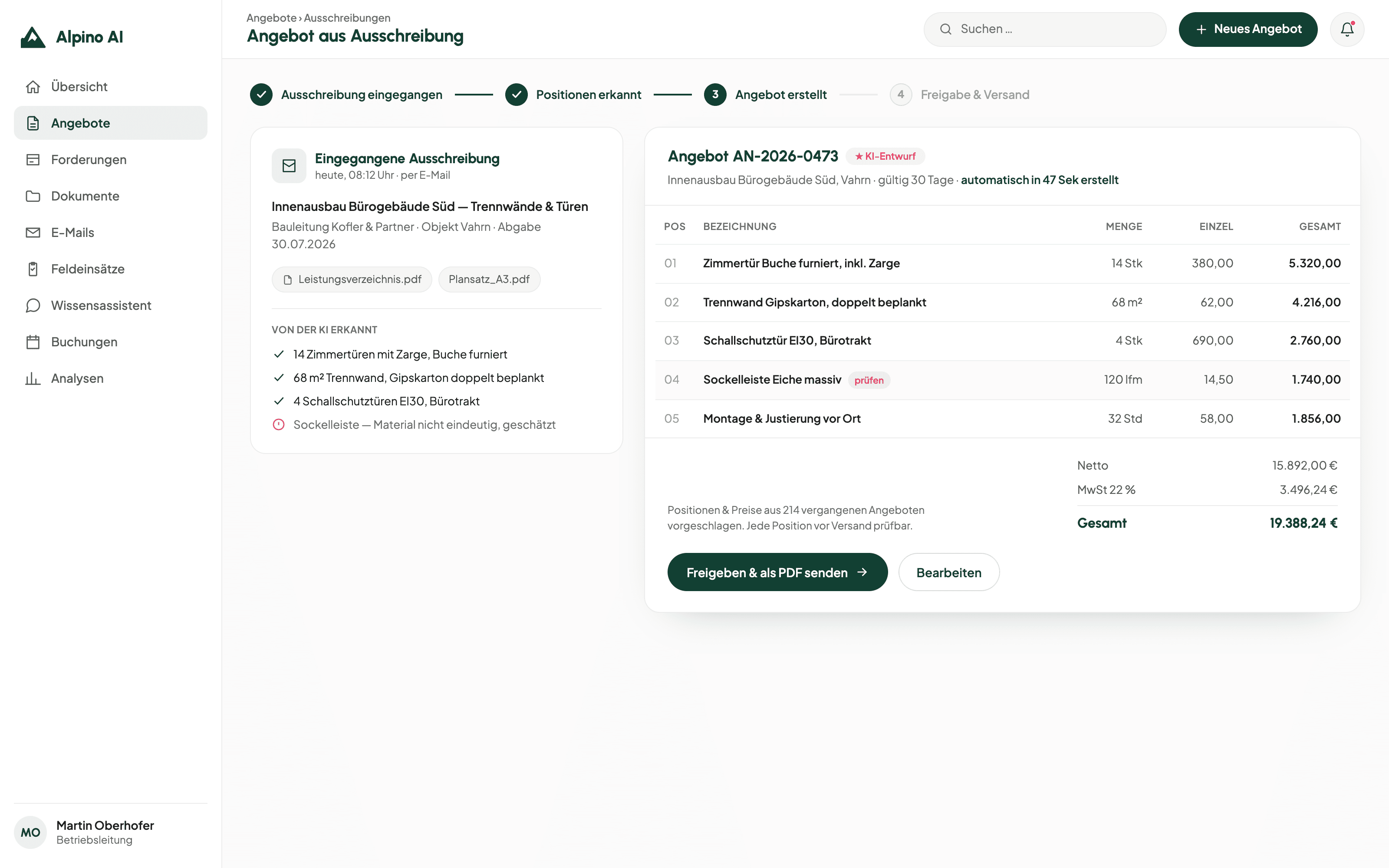 Guide
AI, App and Software Development in South Tyrol
Alpino AI builds AI automation, apps and software for crafts, retail and services in South Tyrol. A regional partner with a concrete benefit.
· 5 min read
Next step
Want to find out where AI actually makes sense for you?
We translate the article into concrete workflows: which task is worth automating, which data is needed and how small the first MVP can be.